
Hair Transplant Turkey: Who Really Operates? 7 Questions to Ask
Transparency notice: This guide is published by Mapa Health, a health tourism agency licensed by the Turkish Ministry of Health (licence AK-0456). We coordinate hair transplants in Istanbul and are paid for that coordination. Please read this as information from a provider, not as an independent review.
Quick answer
Hair transplant Turkey: the result depends less on the price than on who does what in the operating room. In many large clinics the surgeon only draws the hairline, while trained technicians extract and implant the grafts. Before you book, ask in writing which steps the surgeon performs personally, how many grafts your donor area can safely give, and whether the agency holds a Ministry of Health licence. A legitimate agency will give you its licence number. For Mapa Health it is AK-0456.
At a glance
Methods: Sapphire FUE, DHI and classic FUE, depending on your scalp.
Stay in Istanbul: usually 3 days.
Final result visible: after about 12 months.
Most important factor: the quality and reserve of your donor area.
Mapa Health on Trustpilot: 4.5 out of 5 from 108 verified reviews.
Patients coordinated since 2020: more than 500.
Surgeon or technician: who does what?
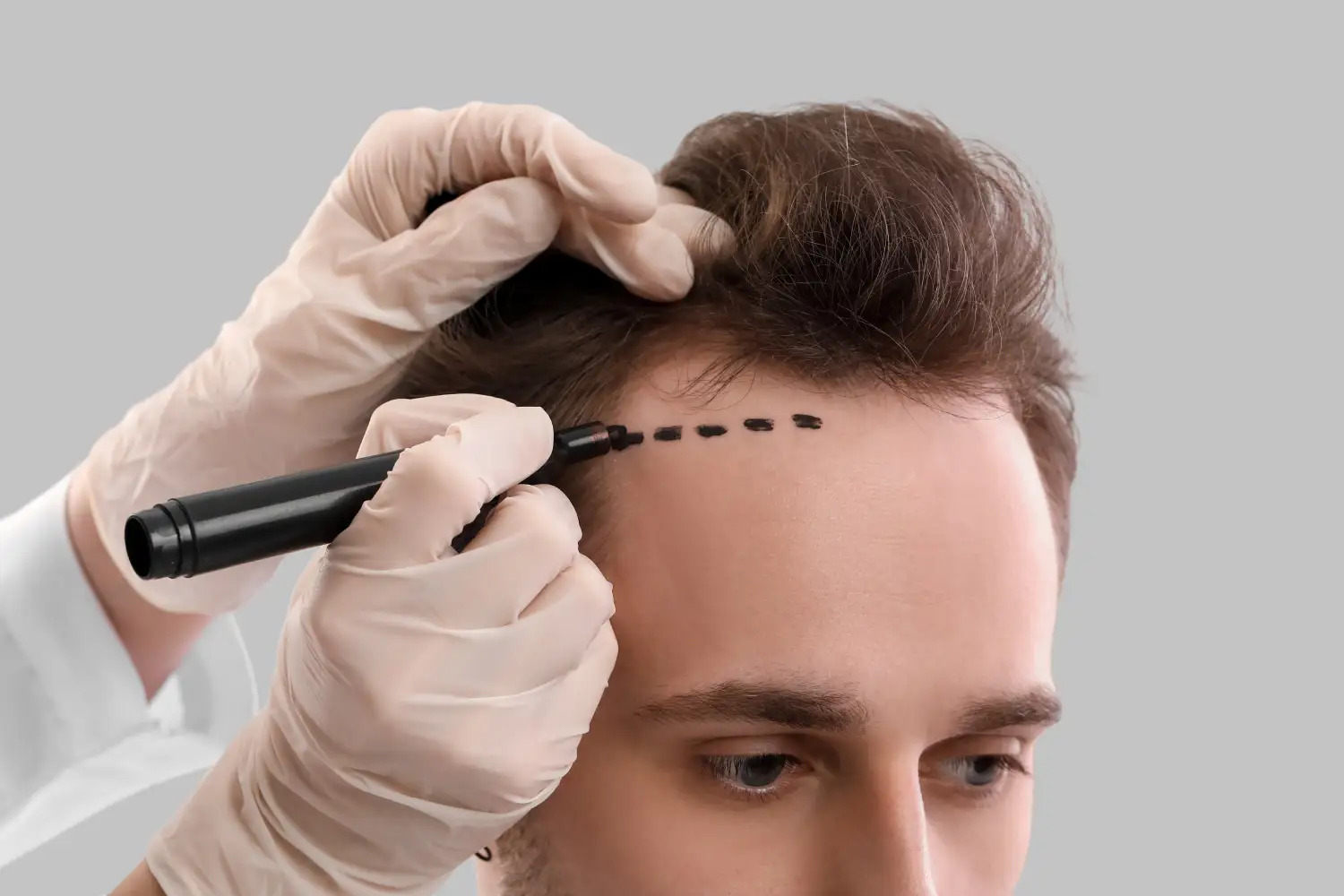
A hair transplant has four steps. First, planning the hairline. Second, extracting grafts from the donor area. Third, opening the recipient channels. Fourth, implanting the grafts.
German media have reported several times that in many Turkish clinics the advertised doctor does not perform most of the procedure; trained technicians do (Heidelberg24). That is not automatically bad, as an experienced team can work cleanly. The problem starts when nobody tells you beforehand.
If a centre performs 20 procedures a day, one surgeon cannot personally place every graft for every patient. So do not ask "Will a doctor be present?" Ask "Which of the four steps will the surgeon perform on me personally?"
At the partner clinic Mapa Health works with in Istanbul, the surgeon performs all four steps personally: hairline, extraction, channels and implantation. That limits how many patients the clinic can treat per day. This limit is exactly why we work with this clinic.
For us this is not a detail but a condition. The hairline decides how natural a face will look, and the extraction decides how much reserve you keep. Both are decisions a surgeon should be accountable for. We do not recommend a clinic that books more patients per day than its surgeon can treat personally.
The graft myth: more is not better
Many offers advertise big numbers: 5,000, 6,000 or even 7,000 grafts in one session. The message is simple: more grafts, more hair. This is the most common piece of misinformation in this market.
The donor area at the back of your head is a limited supply. Hair taken from there does not grow back. If grafts are taken too densely, the back of the head can later look thin or patchy. Surgeons call this overharvesting, and the damage is very hard to repair.
A test report by the German news site t-online shows the problem from the patient side: instead of the agreed 3,000, the author received more than 4,800 hairs in Istanbul and had to pay extra on the spot (t-online). A higher number sounds like a bonus at first. In reality it uses up reserve you might need for a second session in ten years.
The right number depends on three things: the size of the bald area, the density of your donor area and how your hair loss is progressing. A responsible surgeon plans conservatively and explains why.
When someone shows us an offer for 6,000 grafts, we ask one question back: did a doctor look at the back of your head before that number was written? Usually the answer is no. A graft count without an examination is a sales figure, not a medical plan.
Your donor area is a lifetime budget
Think of the donor area as a bank account. Every session is a withdrawal, and there are no deposits. Someone who has a large session at 28 and keeps losing hair at 40 will still need reserve at that point.
That is why the donor area should be assessed at the start of every consultation, before anyone talks about the new hairline. Clear photos of the back and sides of your head are essential for a first assessment. At Mapa Health, the treating surgeon reviews these photos personally before any plan is made.
Who is not a good candidate
An honest consultation also says no. In these cases we advise against a transplant or recommend a medical check first:
Diffuse thinning: If hair thins evenly all over, the donor area is usually affected too. This is common in women. A transplant only redistributes existing hair; it does not create new hair.
Young age with active hair loss: For men in their early twenties, it is often unclear how far hair loss will progress. A hairline placed too low can look unnatural later.
Treatable causes: Hair loss caused by thyroid problems, iron deficiency, medication or stress should go to a dermatologist first. While the follicle is alive, surgery is not needed.
Weak donor area: If there is too little dense hair at the back, the desired result cannot be achieved. It is more honest to say so before you travel.
Unrealistic expectations: A transplant can improve density. It cannot bring back the hair you had at 18 if baldness is advanced.
7 questions to ask before you book
Which steps does the surgeon perform personally: hairline, extraction, channels, implantation?
What is the surgeon's name, and is he or she registered with the Turkish Medical Association?
How many grafts can my donor area safely give, and how many are planned for me?
What happens if a different number is taken on the day? Will I be charged extra?
Which method do you recommend for me, and why: Sapphire FUE, DHI or classic FUE?
How many procedures does the surgeon perform per day?
Does the agency hold a Ministry of Health licence, and what is the number?
The last question is often forgotten. Health tourism agencies in Turkey need authorisation from the Ministry of Health. Mapa Health operates under licence AK-0456. Get the answers to all seven questions in writing, by email for example. What is written down carries more weight on the day than a promise made over the phone.
Sapphire FUE, DHI or FUE: which method?
No method is the best for everyone. Sapphire FUE uses sapphire blades to open the channels and works well for larger areas. DHI places the grafts directly with an implanter pen and often allows treatment without a full shave, for example at the hairline or for women. Classic FUE is the base technique both are built on.
Be careful with advertising that calls any method "risk free". Every hair transplant is surgery, with possible side effects such as swelling, scabbing, temporary numbness and infection. The surgeon should choose the method based on your scalp, not the sales brochure.
The process in Istanbul: 3 days
Day 1: Arrival, transfer, examination and hairline planning with the surgeon. Blood tests before the procedure.
Day 2: The procedure under local anaesthesia. Depending on the graft count, it takes several hours.
Day 3: Check-up, first hair wash at the clinic, aftercare instructions and flight home.
The 12 months after
Many patients get a fright after about three to eight weeks, when the transplanted hairs fall out. This is called shock loss and it is normal: the follicle stays in the skin and grows a new hair.
The first new hairs appear from month three or four. After about six months the difference becomes visible. The final result is judged after around twelve months, sometimes later at the crown.
After you return home, the Mapa Health team stays reachable by WhatsApp and email. Send us photos at set points so the surgeon can follow your progress. If you notice strong redness or fever, please see a doctor at home straight away.
If you are also thinking about a beard transplant, the same principle applies: the donor area is limited, and both procedures draw on the same reserve.
You can find all methods, the process and current terms on the page for hair transplant in Turkey with Mapa Health.
About Mapa Health
Mapa Health is a health tourism agency based in Istanbul, founded in February 2020. Since then we have coordinated more than 500 international patients. We are authorised by the Turkish Ministry of Health under licence AK-0456. Contact: info@mapahealth.com. More about hair transplant in Turkey.
Frequently Asked Questions
Who performs a hair transplant in Turkey, the surgeon or a technician?
It depends on the clinic. In many large centres, technicians handle extraction and implantation. At the partner clinic of Mapa Health, the surgeon performs every step personally. Always ask in writing.
How many grafts do I need?
It depends on the bald area, the density of your donor area and how your hair loss is progressing. A reliable number is only possible after photos or an examination. Very high numbers without an examination are a warning sign.
How long do I need to stay in Istanbul?
Usually 3 days: examination, procedure, and a check-up with the first hair wash.
Does a hair transplant hurt?
The procedure is done under local anaesthesia. Most patients only find the anaesthetic injections at the start uncomfortable. Tightness and swelling can follow for a few days.
When will I see the result?
The first hairs grow from month three or four. The final result is judged after about twelve months.
Can women have a hair transplant?
Yes, if a clearly defined area is affected and the donor area is dense. With diffuse thinning we usually advise against it.
Will the NHS or my insurance pay for it?
Usually not, as it is mostly a cosmetic procedure. Rare exceptions exist, for example after accidents or burns. Check directly with your provider.
How do I recognise a legitimate agency?
By a licence from the Turkish Ministry of Health, a named surgeon and written answers to your questions. Mapa Health operates under licence AK-0456 and is rated 4.5 out of 5 on Trustpilot.
About the Publisher
This article was prepared by the Mapa Health Editorial Team. Mapa Health is a medical tourism coordinator authorized by the T.C. Ministry of Health (Authorization No. AK-0456) since August 2022. Since 2020, Mapa Health has accompanied over 500 international patients to certified partner facilities in Istanbul. For a personalized consultation: info@mapahealth.com