
Hair Transplant at 25: Too Early or the Right Time?
Is a hair transplant at 25 too early? When the procedure makes sense, when waiting is better and how to plan with a reserve.
Transparency notice: this guide is written by Mapa Health, a coordinator for treatments in Istanbul licensed by the Turkish Ministry of Health (licence AK-0456). We arrange hair transplants, so we are not neutral. Even so, we do not recommend a hair transplant at 25 to everyone. Here we explain when the procedure makes sense at this age, and when waiting is the better decision.
Quick answer
A hair transplant at 25 is not too early in principle, but it needs a different plan than at 40. At this age hair loss is often not finished. Anyone who now has a low, dense hairline built with many grafts can end up ten years later with an island of transplanted hair in front of a bald crown. The procedure makes sense at 25 if the hair loss has been stable for some time, the donor area is dense and the hairline is designed to still suit you at 45. Whether that applies to you is decided by the doctor after an examination.
At a glance
Under 20, professional bodies such as the ISHRS generally advise against a hair transplant.
At 25 the procedure is possible if hair loss seems stable and a reserve remains in the donor area.
For most men the donor area holds about 4,000 to 7,000 grafts for a whole lifetime.
A hairline at 25 should not be as low as that of an eighteen-year-old.
Medication against further hair loss is something to discuss with your GP or a dermatologist first.
Mapa Health rating: 4.5 out of 5 on Trustpilot from 108 verified reviews, more than 500 patients since 2020.
Why age matters for a hair transplant
The operation only moves hair. Grafts are taken from the back of the head, where the hair is largely resistant to hereditary hair loss, and placed in bald areas. No new hair is created. The transplanted hair usually stays for good, but your own hair around the new area does not necessarily.
That is exactly the problem at 25. Hereditary hair loss starts in many men between 20 and 30 and progresses over years. At 25 it is often impossible to say for sure whether someone will stop at slight recession at the temples or have a bald crown at 40. The International Society of Hair Restoration Surgery (ISHRS) points out that the later pattern is hard to predict in young patients.
Operating early means planning for a situation you do not know yet. That is no reason to always wait. It is a reason to plan more carefully than for a 45-year-old whose hair loss has not changed for years.
A common myth: the earlier, the better
Many young men hear that you should "operate while there is still something there". It sounds logical, but for many patients it is wrong. A hair transplant does not stop further hair loss. It only replaces the hair that is already missing.
The typical mistake looks like this: a 24-year-old with receding temples has a low, straight hairline placed with a large number of grafts. At 25 the result looks good. At 35 the crown thins. A gap opens between the dense front and the bald crown, and there is hardly anything left in the donor area to close it. The correction is harder than the first operation.
Mapa Health works with a fixed price for hair transplants that does not depend on the number of grafts. For young patients in particular, that does not mean the doctor takes as much as possible. He places as many grafts as your donor area can safely give and as your plan for the coming decades allows. How the number is worked out is covered in How many grafts do I need for a hair transplant?.
When a hair transplant at 25 can make sense
A procedure at this age can be a good fit when several points come together. The hair loss has barely progressed for at least one to two years, which you can check well with old photos. The donor area at the back is dense and shows no thinning. The affected area is limited, for example to the temples. And you accept a hairline that sits a little higher and more naturally than the one you had as a teenager.
Family matters too. If your father, grandfather or uncles still had much of their hair at 40, that is a good sign. If they went bald early, the plan should leave more reserve. It is not a certain prediction, but it is information your doctor should have.
When waiting is the better decision
Waiting is usually better if the hair loss has clearly sped up in recent months, if the crown is also starting to thin or if the donor area itself looks sparse. Anyone who mainly wants a very low, dense hairline like at 18 should also think again. That line often no longer suits the face or the rest of the hair at 45.
For young patients, the ISHRS recommends first establishing the cause of the hair loss and, where possible, slowing it with medication. After about twelve months it is easier to judge how the hair is developing. Whether medication is right for you and which side effects are possible is something to discuss with your GP or a dermatologist. Mapa Health does not give recommendations on this.
What a careful plan at 25 looks like
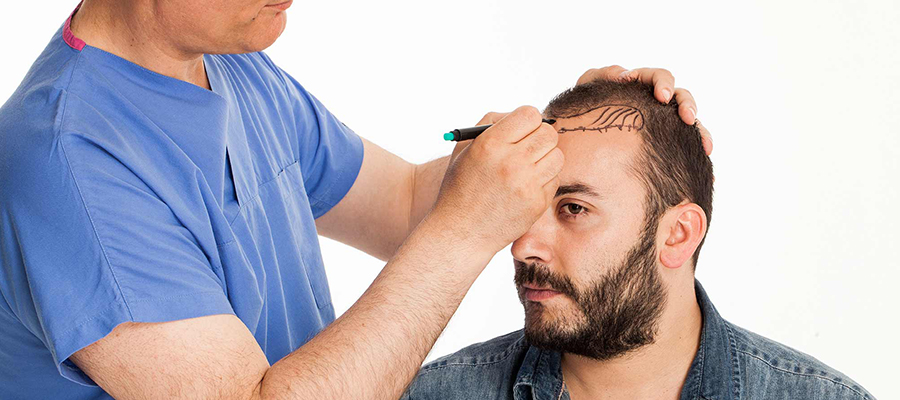
The hairline is drawn a little higher and more irregular, so that it stays natural even if hair loss continues. At the edge the doctor mainly uses single-hair grafts and builds density towards the back. The crown is usually not treated in young patients while hair loss there is still developing. And a reserve stays in the donor area for a possible second session in ten or fifteen years.
At Mapa Health (licence AK-0456) we give you a provisional assessment based on your photos. The final plan is made by the doctor on the first day in Istanbul, after examining your donor area and drawing the hairline with you. The doctor carries out all the key steps personally. Who really works during the operation is explained in Hair transplant in Turkey: who really operates?.
Which technique suits you is covered in the comparison DHI or FUE in Turkey. How the result develops in the months after surgery is shown in Hair transplant results month by month. The procedure and what is included are on the page Hair transplant in Turkey.
Questions to ask every provider
Ask where the hairline will be and how it will look at 45. Ask how many grafts will remain in the donor area after the procedure. Ask what happens if hair loss on the crown continues. And ask whether the provider has ever advised you to wait. A provider who gives every 25-year-old an appointment straight away is not advising, but selling.
Mapa Health (licence AK-0456) tells you openly when we think an operation is too early in your case. We then advise you to take photos a few months apart and to speak to your GP or a dermatologist before you plan a trip.
Who a hair transplant at 25 is not right for
A hair transplant is not right if hair loss is progressing quickly and has not yet been checked by a doctor, if the donor area is thin or if another cause is involved, such as alopecia areata, a thyroid condition or a deficiency. Anyone expecting an operation to stop hair loss for good will also be disappointed. Under 20, we always advise against it. In these cases it is more honest not to operate, or to wait.
Frequently Asked Questions
Is a hair transplant at 25 too early?
Not in principle. It makes sense if hair loss seems stable, the donor area is dense and the plan keeps a reserve for later. If hair loss is still active, waiting is often better.
From what age is a hair transplant possible?
Under 20, professional bodies such as the ISHRS generally advise against it. From the mid twenties the procedure is possible if the doctor considers the hair loss and donor area suitable.
Does transplanted hair fall out later?
Transplanted hair from the donor area usually stays for good. Your own hair around the treated area can still continue to fall out.
Will I need a second operation later if I have one at 25?
That is possible if hair loss continues. That is why a reserve should remain in the donor area, enough for a second session in a few years.
Should I take medication before the operation?
Discuss this with your GP or a dermatologist. Medication can slow further hair loss and change the plan, but it has possible side effects.
Is the crown treated in young patients?
Usually not, while hair loss there is still developing. Treatment focuses on the hairline and the temples.
How do I get an honest assessment for my case?
Send Mapa Health photos from the front, from above and of the back of your head by email to info@mapahealth.com, ideally with older photos for comparison. Mapa Health is licensed by the Turkish Ministry of Health (AK-0456) and rated 4.5 out of 5 on Trustpilot.
About the Publisher
This article was prepared by the Mapa Health Editorial Team. Mapa Health is a medical tourism coordinator authorized by the T.C. Ministry of Health (Authorization No. AK-0456) since August 2022. Since 2020, Mapa Health has accompanied over 500 international patients to certified partner facilities in Istanbul. For a personalized consultation: info@mapahealth.com